 Tell Me About:
  Tell Me About:
Australia has a thriving arts community. Each state capital has major art museums, symphony orchestras, opera, theater companies and libraries. In addition, the country has national ballet and opera companies. The Australian government helps to support both creative and performance arts, including the motion picture industry.
Australians also have a strong literary tradition. My Country is one of the best known poems in Australia. A young Australian wrote it in the early 1900s in the form of a letter to a British friend. The first verse speculates what the friend might enjoy about her own country, and the other verses tell why the author loves Australia. The second verse, beginning "I love a sunburnt country," is the most widely quoted.
The love of field and coppice, I love a sunburnt country, The stark white ring-barked forests |
Core of my heart, my country! Core of my heart, my country! An opal-hearted country, |
Music has always been an important part of Australian people's lives, whether it be pop, classical or Aboriginal music. The Sydney Symphony Orchestra, the Australian Youth Orchestra and the Australian Chamber Orchestra have enjoyed recognition overseas. Opera also has a substantial following, and Australia has produced some remarkable jazz.
Australia also has a huge country and western music following. An annual country and western festival is held each year in Tamworth, NSW.
In popular music, Australia is the third largest supplier of songs in the English-speaking world. Bands such as INXS Midnight Oil , silverchair and the Aboriginal group Yothu Yindi have achieved international success.
National Anthem
Australia's national anthem, Advance Australia Fair, is a version of a patriotic song written by Peter Dodds McCormick (under the pen-name Amicus). It was first performed in Sydney in 1878. Advance Australia Fair was chosen the national anthem in 1984. It replaced God Save the Queen, which is still played in the presence of British royalty or the governor-general.
Waltzing Matilda
One of Australia's most popular poets, A.B. (Banjo) Paterson, wrote Waltzing Matilda as a ballad in 1895. It is the best known Australian song in the world. Some people mistakenly believe that it is Australia's national anthem.

Australian word / expression |
American equivalent |
| Billabong | Watering hole formed by drying river beds |
| Billy | Can with wire handle used to boil water over a fire |
| Coolibah | Type of eucalyptus |
| Jumbuck | Large Sheep |
| Squatter | Large-scale farmer of land owned by the government |
| Swag | Backpack |
| Swagman | Hobo/Tramp |
| Tucker | Food |
| Waltzing Matilda | Carrying a backpack |
Aboriginal Music
When creating music, Aborigines make the best
use of the sparse resources available to them. They use their own voices
and clap together boomerangs, sticks and hands. Aborigines play a unique
musical instrument, the didjeridu (pronouced DID-jer-ee-DOO), at ceremonies
in northern Australia. It is similar to a wood trumpet but shaped like a
bassoon. It is a difficult instrument to play because the player must breathe
in at the same time as blowing through the instrument. This form of circular
breathing is a skill that takes a long time to develop.
Artistic expression is a very important aspect of the Aboriginal culture.
It can take the form of painting, dance or music. Paintings on bark, rock
(on cave walls), wood or the human body are common. Engravings and sculptures
use stone, fiber, fur and leather. Most Aborigines would consider themselves
artists.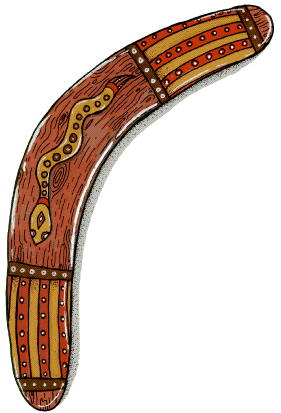
Subjects
Aborigines make pictures of a wide variety of
subjects. These include mythical beings, humans, birds, fish, reptiles and
animal tracks. They can also be more abstract designs. Many are connected
to the Dreamtime. Abstract designs often contained coded information. Only
Aborigines who go through an initiation ceremony know the meaning.
Colors
Aboriginal painters traditionally use earth colors - red, browns, yellows, black and white. They make paints from natural ingredients such as ochre, ash and charcoal.
Some Styles
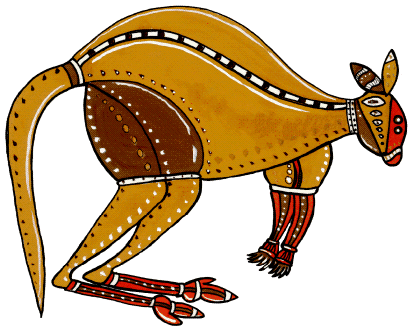
Aborigines also make hand stencils on cave walls. The artist holds an object, frequently a hand, but sometimes a foot or a boomerang, against the rock. Then the artist sprays paint from the mouth as a form of stenciling. "X-ray" paintings show the internal anatomy of an animal, such as the skeleton and heart of a crocodile, fish or kangaroos. These paintings express many stories about the different animals. Until Aborigines began painting with dots on canvas in the 1970s, bark paintings with dots were the best known form of Aboriginal painting. The dots imitate the sand paintings that artists used to create directly on the ground. The symbols in the dot paintings represent a variety of items, including water holes, mountains, animals, tools and people.

 MUSIC
MUSIC