 Tell Me About:
  Tell Me About:
 Sports are a way of life in Australia. The country's mild climate enables people of all ages to enjoy a variety of sports throughout the year. About one-third of all Australians are registered sports participants.
Water Sports
 Most Australians live on or near the ocean. Water
sports are among the most popular forms of recreation. Swimming, surfing,
scuba diving, sailing, power boating and fishing are many of the ways Australians
enjoy the water. Surf lifesavers (lifeguards) patrol beaches and if necessary,
row or swim out to rescue people. Over 25,000 volunteers staff the country's
Surf Lifesaving Clubs. They hold contests of speed and skill to improve
their ability to react quickly and efficiently in emergencies.
Most Australians live on or near the ocean. Water
sports are among the most popular forms of recreation. Swimming, surfing,
scuba diving, sailing, power boating and fishing are many of the ways Australians
enjoy the water. Surf lifesavers (lifeguards) patrol beaches and if necessary,
row or swim out to rescue people. Over 25,000 volunteers staff the country's
Surf Lifesaving Clubs. They hold contests of speed and skill to improve
their ability to react quickly and efficiently in emergencies.
Australian Football and Rugby
 Other popular sports include Australian Football,
commonly known as Aussie Rules, and two codes of rugby, Rugby Union and
Rugby League. These are action-packed games with 18, 15 and 13 players per
side respectively. They are somewhat similar to American football. The offensive
team tries to drive the ball past a set area at its end of the playing field
into a goal. The defensive team tries to prevent this by intercepting the
ball or tackling its opponents. They are played with balls that are slightly
different in shape and size from American footballs.
Other popular sports include Australian Football,
commonly known as Aussie Rules, and two codes of rugby, Rugby Union and
Rugby League. These are action-packed games with 18, 15 and 13 players per
side respectively. They are somewhat similar to American football. The offensive
team tries to drive the ball past a set area at its end of the playing field
into a goal. The defensive team tries to prevent this by intercepting the
ball or tackling its opponents. They are played with balls that are slightly
different in shape and size from American footballs.
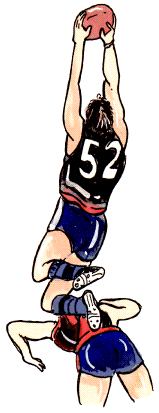
The similarities stop there, however. All three games include more kicking than American football. Rugby players can only pass the ball backwards. Play is also much faster, with no huddles or time-outs taking place during the game. Once a player is substituted, the starter cannot go back on. Aussie Rules is an aerial game where players frequently leap high off the ground to catch the ball. Despite the heavy tackling, players use little padding and no helmets.
American Football
American football has a small following in Australia, but mostly as a spectator sport. Television stations broadcast one game per week during football season.
Cricket
Cricket is also very popular. In the past, it was played mostly by men and boys. Cricketers play in the summertime on an oval field. There are two teams of 11 players each. The leather cricket ball is slightly larger and heavier than a baseball. It has one seam. The bat is round on the back side and flat on the facing side. It is about four inches wide. There are two batsmen (batters) on the field at any one time, each with a bat in his hand. They each stand in front of a wicket, which is a pair of bails (horizontal wooden pegs) balanced on top of three vertical stakes. A wicket is located at either end of the 22-yard cricket pitch in the center of the field.
 The bowler (pitcher) must bowl (pitch, usually
with one bounce) the ball to one batsman. He tries to hit the ball. The
bowler and defensive players, meanwhile, try to knock off either wicket
by hitting it with the ball. If this happens, the batsman who is batting
at that end of the pitch is called out. He is also out if he hits a caught
fly ball. All but the wicket keeper (catcher) must catch the ball with bare
hands.
The bowler (pitcher) must bowl (pitch, usually
with one bounce) the ball to one batsman. He tries to hit the ball. The
bowler and defensive players, meanwhile, try to knock off either wicket
by hitting it with the ball. If this happens, the batsman who is batting
at that end of the pitch is called out. He is also out if he hits a caught
fly ball. All but the wicket keeper (catcher) must catch the ball with bare
hands.
The batsman scores a run when he changes places with the other batsman without either wicket being knocked off. A batsman can also score four runs for his team when the ball touches the boundary, or six when it flies over the fence. Every offensive player but one must be called out before the defensive team gets to bat. An innings (sic.) is complete when both teams have batted. The winner is the team that scores more runs during its two innings. A cricket game usually takes five days to play at the state and international level. The players wear white or cream uniforms. Local men's and women's leagues and children's competitions frequently play 1- and 2-day games with a single limited innings.
Netball
Netball is Australia's most popular organized
sport, as measured by registered participants. It is somewhat similar to
basketball. Netballers play on a court between two goals, each with a ring
but no net or backboard. Unlike basketball, however, players cannot dribble
the ball. They move the ball up the court by passing it around. Netball
is traditionally a female sport, but many men and boys now play it in community
leagues.
Basketball and Baseball
The American sports of basketball and baseball are gaining in popularity in Australia. Players can now play in professional leagues. Basketball, especially, has grown tremendously in recent years. The annual attendance for Australia's National Basketball League, founded in 1979, is more than a million. Many school children play basketball on the playground and on local club teams. They follow the US National Basketball League with great interest.
Local clubs organize most sporting events for children. Schools generally run one-day tournaments for such sports as boys' and girls' soccer, volleyball, basketball and softball. They invite a number of other schools to participate. Public school teams do not play a series of games in a school league, as they do in the United States. Most schools hold an athletic carnival (field day) each spring. Winners go on to regional, state and national championships. Many children living near the beach also join Surf Lifesaving Clubs, where they practice swimming and lifeguarding skills.
The International Olympic Committee selected Sydney, Australia to host the summer Olympic Games in September 2000. Australia last hosted the Olympics in 1956 in Melbourne. Sydney will also be the site of the Paralympic Games that year.
Australia is one of the very few countries to have competed in every summer Olympic Games. As of 1992, Australians have won 78 Olympic gold medals, with swimmers having the most success. In Olympic Games held between 1948 and 1992, women won more than 40% of Australia's gold medals- a remarkable achievement since only 23% of the events were available to women.
 Fun Fact: Show Your True Colors
Australian international sports participants wear green and gold, the national colors. They are the colors of the country's floral emblem the gold wattle. |
 ORGANIZED
SPORTS
ORGANIZED
SPORTS